Mobile Logo
Brescia logo tab

History

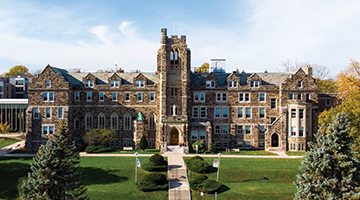
The Brescia campus

Brescia's History

Brescia University College was founded in 1919 by the Ursuline Religious of the Diocese of London. The Ursuline Sisters are strong women of faith who are committed to social justice, community service, and the development of women. Their vision and values continue to help shape the policies and procedures at Canada’s women’s university.

Originally, Brescia was located in a converted house downtown near Victoria Park. Seven young women comprised the first class of students. Land was later purchased and, in 1923, construction began on what is now Brescia University College. Classes began on the new campus in fall 1925.

Since its inception, diversity has been important to Brescia. In the early days, women came from the Caribbean, Latin America, and Asia to study at Brescia. Today, Brescia welcomes and embraces women of all faiths from all over the world.

The Ursulines ensured that all women, regardless of financial circumstances, could pursue a Brescia education. To this day, Brescia is known for our outstanding scholarship program.

Unique Furnishings at Brescia University College

Written by Sister Corona

Brescia University College is an institution that is rich in heritage, which is reflected in the historical buildings on campus. Ursuline Hall, the main building of Brescia, is in Tudor Gothic architectural style made with Trent Valley stone in tones of grey and red. Erected in 1924-25, the building was largely paid for by the Reverend Mother Clare Gaukler’s mother, Josephine Gaukler. Josephine was a great benefactress of the Ursulines. She also donated Glengarda, a beautiful estate on the Detroit River. Her picture hangs in the Rose Parlor and a plaque in the Beryl Ivey Library commemorates her generosity to the cause of religious education.

Planning for Ursuline Hall was carried out by the architect firm Pennington and Boyd under the supervision of Reverend Mother Clare (the Superior General) and Mother St. Anne, the first superior of Brescia. Chapel plans were created by Mr. Anthony and carried out by the Piggott Company. The contributions of all of these people added much to the perfection of Brescia.

The chapel in Ursuline Hall is filled with treasures from Brescia’s past. The gold tabernacle, candlesticks, and crucifix were made in Belgium and erected in memory of the Gauklers. The antipedium is of gold thread donated by Mrs. Agnes Pocock, who also gave $200 for the painting of the chapel in 1944.The white marble pedestals were the gift of Mr. Francis Gaukler. The large wooden pedestals were procured by Mother Gertrude. Mr. Cain of Stratford carved the seven-branched candlesticks on the pedestal. The beautiful Rood Screen and the angels on the Riddel posts were all Italian made in New York. The Baldacchino and stalls were made by the Globe Furniture Company of Waterloo, Ontario.  The colouring, the delicacy, and design show Reverend Mother Clare’s exquisite taste and love for the “Altar of God.” The windows of Our Lady’s shrine are of Munich glass, donated by Mr. John Boyd, the architect.  The other stained glass windows were produced in Toronto.

Located in the rotunda, the statue of the Sacred Heart, the statue’s pedestal, and the central chandelier were the gifts of Mrs. George O’Neil. The rotunda idea was borrowed from Boston College, a Jesuit institution outside of Boston. It is built of Caen stone and was adapted to become an entrance. All the statues, as well as the pedestal, are of Carrara marble imported from Italy.

The marble stairs were designed to lead up to a statue of Our Lady and were to be called Our Lady’s Stairs and our Lady’s Halls (upstairs). While waiting to purchase a suitable statue of Our Lady, a gentleman from Chicago sent Mother Gertrude the Little Flower statue, which was placed on the pedestal. There is no statue of her elsewhere in the house except the one in the Chapel.

The hall outside the chapel is as historically significant as the chapel itself. The iron gates were bought in Venice by Mother Clare when in Italy for the Holy Year in 1925. She was in a gondola when she noticed an antique shop where the gates were displayed. In order to make them fit their present location, Mr. Piggott had frames cut in the plaster at both sides of the doorway, as the gates were slightly larger than the Hall. The picture of the Holy Family by Murillo was painted in Europe and was placed in the present large frame that came from the Whiskard home where Brescia was located in the 1920s. It was erected in a place of honour in the corridor to remind the community of its dedication to the Holy Family by the foundress of the Chatham Ursuline Sisters, Reverend Mother Xavier leBihan, in the pioneer days at “The Pines.” Its re-dedication by Reverend Mother Clare Gaukler occurred on October 3, 1926. There is a framed account of this dedication in the Cloister Hall. The life-size oak panel of St. Anthony was created in Mexico. This panel was stolen from a Franciscan Monastery during the persecution of Christians in Mexico in the 1920s, but purchased from an art dealer by Mr. Joseph Bower, brother of Mother Immaculate, and was presented to her for Brescia. The life-size crucifix was a gift of Desmarais & Robitaille Company, Montreal, who were very devoted to Mother Clare. The pictures of the seven stations of Our Lady of Sorrows came from the Boston Museum of Art.

The Rose Parlor and Dining Room

The furniture in the Rose Room across from the chapel was shipped to St. Angela’s from New York for storage. This received the name of Brescia’s Follies. The French Empire Table was donated by Mr. Francis Gaukler. The large buffet was found by Reverend Mother Clare on the back porch of an antique shop in Stratford. She paid $15 for it, much to the surprise of the owner, who wondered what use she could make of such an old and dilapidated piece of furniture. A Mr. Merrifield of London refurnished the table and chairs in the Dining Room. A wood carver in London did the carving of the handles and the panels of the doors, which were designed by Mother Clare. The buffet is made of butternut, and the carvings of walnut. The Spanish Varguena (writing desk) was bought in Palm Beach, Florida by Colonel Maclean of the MacLean Publishing Company and was presented to Mother Clare.  It is believed to have been carved during the Spanish Renaissance (1500-1650).  Colonel MacLean thought this unusual piece would be preserved and appreciated at Brescia Hall. The candlesticks on the buffet were brought from France by Mother Xavier Le Bihan. They were used on the altar during the pioneer days of the community in Chatham. The mantelpiece was the gift of Mr. Joseph Piggott, the contractor. The mantelpiece was found in Ryan’s Antique Shop in Toronto in 1925 when Mother St. Anne was shopping for furniture. She was anxious to buy it, but the price was too great. After she left the store, Mr. Piggott learned that Mother was anxious to have the mantel so he told Mr. Ryan to include it with her other purchases. The picture of St. Anthony, which was bought in Europe, fit perfectly over the mantel. Raphael’s Madonna of the Chair, and Murillo’s St. Anthony, and Fra Angelico’s Angels were procured in Italy. They are replicas of the originals in the Pitti Palace in Florence. The set of dishes with the red and gold design was a gift from Mrs. Gaukler. The chandelier was recently donated by Mrs. Peever. Many of our pieces of glass and china were purchased at auction sales by Mrs. Margaret Darcy and Miss Mary Crotty.

Library

The large table in the library was procured in Kitchener by Mother St. James through the generosity of inspector Mr. Langen, who was a member of the Public Library Board. He told Mother of this table, which was no longer needed by the Library. The oil painting London a Hundred Years Ago was given to Mother Clare by Mrs. Leo Murphey, who took lessons in art from Mother Clare years before at The Pines in Chatham. The pictures over the door leading into the stacks were given to Mother St. Anne by Mr. Chisholm of Duluth. An oil painting of rural scenery was created by Mrs. Kate Ryder.

Social Room and Hall

The Large Madonna of Murillo was saved from a fire in the New York home of Miss Ashplant, a shoe dealer. Mrs. Peever obtained it and gave it to Brescia.  It was badly damaged, especially the frame, which was remodeled by Mother St. Dominic in accordance with the original design, enough of which was left to guide her. The former owner came to see the restored piece of art. The gold pedestals were donated by the Gauklers. Autographed photos of King George V and Queen Mary were sent to Mother Clare, who attended a royal garden party when in Europe in 1925.

Guest Suite

The furniture and rug were donated by Mrs. George O’Neil. The large arm chair was a gift of Reverend Father Ford when he was the pastor in Strathroy. The filigree Byzantine artwork showing Our Lady on a pedestal was a gift of Mr. Joseph Bower. The framed marble mosaic of an angel came from Florence. The mirror over the mantel in the guest suite belonged to Jane Rennie, an aunt of Mother Immaculate (Dwyer). This, along with a set of six small chairs, two arm chairs, and a couch, were given to Mother Immaculate after her Aunt’s death. Mother immaculate was Superior of Brescia following Mother St. Anne.

Little Flower Hall

The curio case was a gift of Mr. Gaukler. The crucifixion fish was picked up by Mr. Trebilcock in Florida. A wood cut and linoleum cut of Bishop Fallon and his Russian wolf hound was done by Mother St. James. The coins in the case are some of the first coins made in the Vatican City. The leaf from a printed Book of Hours of the 16th Century – printed on vellum by Antoine Venard – was a gift of Carola Sharp, as was the framed rose piece of tapestry. The enlarged photos of bishops were tinted by Revered Mother Clare. The crucifix on the wall near the curio case was given by Miss Isobel Dwyer, a sister of Mother Immaculate, in 1927. The tables and chairs of teakwood were donated by Mrs. Agnes Pocock.

Miscellaneous

The large cupboard in the community room came from the original Brescia building, where it was used as a book case. It originally belonged to the Whiskard family from whom the house was bought. This was replaced by a new cupboard in 1960. The large crucifix in the community room was brought by Holland farmer Peter Leyser, who went there for a visit. It is now located in the nuns’ refectory. The picture of the head and shoulder of Our Lord Agony done in dark colour, which used to hang in the community room, was given to Mother Clare by a woman in Chatham.  She asked Mother to place it where the Sisters could see it often and pray for her son the artist, who left the Franciscan order. The pictures hanging in the wing were framed by Mother Rita and brought from Europe by Reverend Kathleen.

Statuary

The Crucifixion Group was a gift of the Cunningham family. The Shrine of the Holy Family was a gift of Dr. and Mrs. Peever. The statue of Our Lady of Brescia over the main entrance was a gift from Mr. James McIntyre of San Diego, California, the brother of Mother M. Dolores.

Vases on Mantelpiece (Rose Room)

These vases are cloisonnier with enamel designs of gold or copper bands applied to porcelain or metal. The gaps or partitions between these bands were next filled with enamel powder, or paste in colours. The whole was melted into glass in the furnace. This form of artwork was famous in Byzantine art.

Chapel Windows at Brescia

Among the many historical buildings and artifacts at Brescia, the Chapel windows are of marked beauty and significance. There are two small windows in the Lady’s Chapel. They are made of genuine stained glass and were created in Munich. They depict scenes from Mary’s life.
The six large windows in the Chapel are made of painted class and were created in Toronto. They are as follows:

1. Vierz ehn heilige Nothelfer (14 Holy Helpers)

This window located beside the choir loft depicts Mother Clare’s devotion to German. The names are in the window.

2. Sacred Heart; Our Lady of Prompt Succor

This window beside the rood screen depicts two devotions of the Ursulines in early times. The top scene shows Ursuline martyrs in the French Revolution. 
The bottom scene depicts Mary of the Incarnation arriving in New France.

3. St. Ursula

This window depicts scenes from her life.

4. St. Angela

This window depicts scenes from her life.

5. Blessed Virgin

This window depicts scenes from her life.

6. Christ the King – on the Cross as King, Priest, and Victim

This smaller window is located beside the altar. The lower portion shows portraits of seminary staff and Bishop Fallon, modeling their patron saints.